Ang mga karbaw

Poetry by | September 11, 2022


Naglusong sa lutak ang karbaw nga lata.
Kun lantawon ini, daw nakaluhod.
Kun maglakat daw naga kamang.
Ang iya sungad kag agtang
naga tandog sa iya gina arado,
ang iya ikog naga ubo sang maitom nga aso.
Ang iya panit nga pula naga baga
sa panan-awan ko kapin pa sa kasilaw subong aga.
Sa naga singkal nga init sang nakayuhom ang adlaw
sa mahawan nga bagatnanon nga langit
ini nagpakadto-pakari, naga arado sang uma ni kumpare.

Duha ang naka sakay sini nga karbaw,
si Manong Dante nga naga palakat sini pakadto pakari
uyat ang bilog nga karito imbis nga lawig,
kag si Tonton, iya nga subang
nga naga kapot sang inogtanom nila nga humay.
“Ay abaw kapisan sang karbaw, sa pag-agi dayon na-tanom ang humay,”
nag-dayaw ang nag-agi nga Inday
sa iya naagyan nga karbaw kag mag-amay.

Sang wala madugay, natapos sila tanom sang humay
“Baw, kadasig lang gali sang isa ka ektarya,” siling sang balhason nga amay.
Kag gin-tawag na sila ni kumpadre nga tag-iya,
“Isaka na ang makina kay mapanaw run ta.”

Ako man amat-amat nga nagpanaw,
Akon naagyan man isa ka itom nga karbaw kag tinday.
Naglusong sa turugban nga daw naga spa ang mag-nanay.
“Ungaaa,” malipayon sini nga pag-tingog,
sa kilid sini may ara tigulang nga nakatindog sakahon,
ang mal-am naga kumod kag akon siya nga ginpamangkot,
kamusta ang ila nga sab-og,
“Ay pare,” iya nga sabat, “wala na sab-og kay nag-tanom na
kami ni pare gamit ang iya nga lata nga karbaw.”
Ako man nagsabat, “Ay, ti kanugon ining imo nga karbaw.”
Ginabaligya ko na ini, sugid sang mal-am.
Pero wala pa ako naka sal-ot, ini liwat nag-kumod:
“Abaw, ka barato sang bili. Kundi ako dulang
mag-Bulcachong kag mag-tapa sini.”


John Dominic Arellano is an accountant presently splitting time between Davao City and Koronadal City. He was born in Norala, South Cotabato. Some of his works were published in Cotabato Literary Journal, and in his zine “Hide and Seek.”

Abyan

Poetry by | August 29, 2022


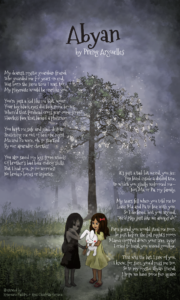
Princess “Preng” Arguelles is taking up a BA English (Creative Writing) course in UP Mindanao. She hails from Compostela, Davao de Oro. Abyan comes from the Cebuano root word abay, which means companion. An abyan is a spirit wedged between being a friend and a guardian.

Illustrators: Rosemarie Padillos and Ross Charlotte Gersava

A Dam in Calinan

Nonfiction by | August 29, 2022

We stood at the foot of a tree-studded hill in Calinan. Mia, my classmate, seemed just as eager as I was to climb it, as we looked at the steep path we were about to take. I took the lead, with each mindful step at every convenient tree root that stuck out like nature’s staircase. It was clear that there was a trodden path ahead, as the rest of the hill was filled with cogon grass and trees too close to each other to walk through. About a third of the climb, sweat started to soak my neck and back. The Saturday afternoon sun wasn’t the one to blame, as the path was mostly shaded by mahogany trees that lined the hill. I remembered Troy, my classmate, saying that he used to climb this same hill every week for his taekwondo training. Despite being half my size, Mia managed to keep up with me and after a hundred sweaty steps and dirt-covered limbs, we reached the top. It was anticlimactic. I thought I would hear Howard Shore’s “Concerning Hobbits” at the supposedly majestic sight, but the feeling was mundane, at best. At least I got to feel what it must be like to train as a taekwondo athlete.

We rested just right on the path we took and had a chat. She opened up to me and wondered if she was worthy as a scholar of UP. I mean, how am I supposed to answer? I was at the edge during that semester and years later I would shift from my computer course to creative writing. I was just as, if not more, anxious as she was. All I told her was that everyone has their own insecurities, and how we adapt to them is how we succeed. Or at least that’s what I thought I said. I was a naive 19-year-old back then.

But the hill wasn’t why we were here.

One requirement for Comm 3, Effective Speech Communication, was to interview a community. The pairwork task was mostly focused on the techniques, methods, and ethics of interviewing. Simple enough. The harder part, however, was selecting what community I should go to. The only places that I was familiar with in Davao were the Roxas Avenue-Mintal jeepney travel route and their adjacent landmarks like Gaisano Mall and Ateneo de Davao University. So communities within the city were a no-go. I thought about going back to my hometown, Banaybanay in Davao Oriental for it, but I didn’t want to think about the fuss of bringing a girl back home. Mia was probably thinking the same thing as well. The only idea that we agreed upon, after much deliberation, is to visit a nameless dam in Calinan. The climb up the hill was just an excursion after a long ride from Calinan market.

Yes, it doesn’t have a name. Even Google couldn’t provide an answer. We agreed on it because it was the only place we were both familiar with in Davao. We had both been to a half-built resort owned by Troy’s uncle right next to the dam. We could’ve just been casual about it and interviewed anyone in the Mintal market, but we were UP students chasing excellence even if it meant a dangerous journey to the Calinan outskirts. Damn, we were really trying hard.

We took the same steps in our descent and walked towards the dam, as dry and rusty as we had seen before. On the reservoir side was a knee-deep stream and the downstream hardly had any water in it. What it had, however, were large rocks and patches of cogon grass, as if the last time it had water flowing was a decade ago. The concrete parts of the dam itself were covered in green and yellow slimy moss. The metal gears, screws, and platings were caked in orange rust. There were no maintenance buildings, no workers in the vicinity, and no cable lines for power. Just an antiquated, derelict structure.

So imagine my surprise when I found out that it was still working.

The fact came from the villagers near the dam, who seemed watchful of the two young visitors. It was as if they hadn’t seen another soul in years. We ignored them for a while but appreciated that we didn’t have to search hard for anyone for the interview. After about an hour of chatting, it was about three in the afternoon so we hopped through the large rocks on the downstream side towards the village when we saw one of the women standing beside the dam as if she were waiting for us. When she thought we could hear her, she said, “Why did you climb that hill? It’s extremely dangerous up there!”

My nonchalant heart suddenly jumped. The woman’s words sounded more concerning when a few of her fellow villagers walking by suddenly turned to us as if their everyday activities shifted into our supposed trespass.

“Why is it dangerous?” Mia asked.

“There are tulisan up there!” the woman answered.

Bandits? I felt a sudden and more sinister atmosphere in the area. Up there on the hill, it was a deafening silence, and we didn’t feel any souls hiding, waiting to pounce on us and have their way.

We were led to a sort of a wooden shed in which the woman, accompanied by her husband and some of her neighbors, told us that the hill and the nearby dam are witnesses to robbery, rape, and murder. The woman, as she relayed her story to us, spoke in hushed tones as if talking about it loudly would attract the malicious entities that lurk in the place. She mentioned a couple who were attacked when they were taking a bath at the reservoir. Then she answered no further questions about the matter, emphasizing that we should avoid that place from now on.

Duterte would win the elections as president the following year. When the rumors of him running for the presidency ran rife, the posts, images, or testaments on social media of how peaceful Davao City is also increased. Oppressive policing aside, the city was indeed relatively peaceful. But with their focus on urban security, it seemed they had forgotten that the dam, the village, and the hill were still part of their jurisdiction. So it seemed that the wicked lurked in the outskirts, away from the public.

As soon as I returned to my boarding house, I went online to search for any reported crimes in Calinan. The villagers in the nearby dam treated the atrocities as frequent occurrences so surely the authorities or the local news have information about it, right? The internet said no. But, I couldn’t blame the lack of coverage. Most of the news on TV is focused on the National Capital Region so local reports are mainly available only in the local news, amidst the titillating and sensationalized gossip about Filipino celebrities.

What made me more uncomfortable about all of this is that even though it was clear that the villagers were fearful about what was happening near them, they just agreed to avoid being involved when it happens. As the woman spoke of the couple, I imagined that if one of them had screamed, the villagers could’ve heard them. Perhaps they thought that apprehending the criminals at the scene would have consequences they were not willing to face, so they simply chose to be deaf to what happened. They had no reason to kid us. The woman stood there waiting when we were hopping on the large rocks as if we were her children caught lollygagging in the middle of the night.

But am I being a hypocrite? Because after the trip, I wished that we could’ve just settled for points of interest within the Mintal neighborhood of UP and be done with it. Screw grades and all that. I admit that Davao would’ve felt safer for me if I didn’t know what was happening near the dam. Bliss in ignorance was something I couldn’t deny. I would’ve just been fine with nothing but fascination that the dam was still working. I felt this not because I don’t feel pity, but because like those villagers, I was just as powerless. How could a listless, uninspired 19-year-old college student be able to do anything about that situation? How could I have made things better in that place when even the local police didn’t seem to help? And what about the local government?

I don’t see myself returning to that dam anytime in the foreseeable future. I can’t see myself willfully continuing to ignore what was happening on that hill. My conscience would be banging my head until it couldn’t be ignored anymore. But, years later, I still think about the dam, and how on earth it is still working. I think about the villagers, who kindly offered to take us home as one of them owned a jeepney that delivers the village’s vegetable produce to the Mintal market.


Carl Undag proudly lives in a small town in Banaybanay, Davao Oriental. He is currently completing his BA English course in UP Mindanao to fulfill his dream of writing a novel.

Editor’s Note: The research project referred to in the essay was conducted in 2015. We assure the public that UP Mindanao has since created a Research Ethics Committee and is currently implementing a standard protocol on all research on human subjects conducted by its community. 
Daddy Would Forget

Nonfiction by | August 22, 2022

1. 

July 15, 2021, 7:58 pm

Daddy still remembers me.

My grandfather has seen lots of things in his time. His children growing up. Their belongings being loaded onto a truck because they couldn’t pay the rent. Plaza Miranda right before it was bombed. Sometimes I think Daddy has seen too much.

In 2018, he was a victim of a motorcycle hit-and-run and had to get stitches. In 2019, he was rushed to the ICU for septic pneumonia where he was also diagnosed with dementia. These things seemed to happen more and more frequently.

I prayed then. I asked that Daddy live long enough to see my cousin finish med school and become a doctor. That’s all I asked. And He knows I don’t ask for much. I don’t ask; I don’t dream. No, that was my cousin. That was Ate Hannah.

And in 2021 she finally got her dream. The first doctor in the family. And the way Daddy smiled when it sunk in will always be how I remember him.

I have to check my UP results.

8:12 pm

I didn’t get in. 

I’ll appeal. Everything’s going to be fine. I told myself this. Then:

My mother’s going to be upset. Then:

Mama Ving must be so proud of her daughter, Ate Hannah.

July 18, 12:38 am

I was helping Daddy to bed.

“Anong pangalan mo?” he asked me.

“Bea po.”

“Ilan kayo magkakapatid?”

 “Dalawa po.”

 “Sino ‘yong isa?”

“Si Carlos po.”

“Ahh! Si Caloy!” No one has called my brother that nickname since he was small.

“Tumakbo na ba si Robredo?” he asked suddenly.

“‘Hindi pa po natin alam.”

“Dapat manalo ‘yon… kasi… babae… taga-Bicol…” My grandmother was from Bicol. “Saka Katoliko, katulad ko… naniniwala sa Diyos… hindi tulad ni Duterte… ‘di ‘yon naniniwala sa Diyos.” How could a man who has been put through so much still have this much faith? “Mananalo ‘yon… kasi… natalo niya na si Marcos noon eh.” I thought he was confusing timelines again for a moment then I realized he was referring to the vice-presidential race in 2016. 

It must be nice, I thought, to have so much faith in something.

11:45 am

 Daddy asked again, “Anong kurso mo?”

Literature po.”

“Saan ka mag-aaral?”

La Salle po.”

 “Eh ‘di ba sa Ateneo ka may scholarship?”

“Opo.”

It was quiet for a while.

“Mahal ang tuition sa La Salle, ‘di ba?”

“Hanapan po namin ng paraan.”

As soon as I let go of those words I wanted to take them back. This man has heard them enough. We’ll find a way. Probably mostly from himself. For his family. For us. Too much. Too much.

It’s fine, I sighed, he probably doesn’t remember.

2.

 July 18, 10:31 pm

I was holding Daddy’s hand. He wore a bracelet that had his name and my aunt Mama Lou’s number in case he wanders again. This same hand handed my mother a hammer at the noise barrage in 1978 when supporters of Ninoy Aquino flooded Metro Manila’s streets in an act of defiance against Marcos. I wonder if he remembers that. He looked down at the bracelet.

“Sinong nagpagawa nito?”

Mama Lou was also in the room. She answered, “Nanay niya, si Memen.”

Earlier this year, January 31, Daddy wandered out of the house in Manila before dawn without a face mask on and wearing just a sando and boxer shorts. Barangay tanods found him and asked for his name and address but he couldn’t answer. All he said was that he fell asleep at his daughter’s house looking after Bea and Caloy and wanted to go back home to his wife Nora.

His heart and mind were in Davao. The bracelet was meant to bring him back.


3.

July 21, 9:17 pm

He asked, “Kailan ang kaarawan ko?”

“Sa Biyernes.” Daddy would turn ninety on July 23. We would attend mass at Quiapo Church. My grandmother would always attend mass there. She would fall on her knees and move closer and closer towards the altar. Closer and closer.

“Naku! Bawal ang karne!”

“Daddy, hindi naman Lent ngayon.”


4.

 July 23, 8:07 pm

Mass ended at 8:00 pm.

“Saan si Nora? Nakasimba ba siya? Hindi nagpaalam?” Daddy looked hurt.

“Nasa Davao siya.” Mama Lou answered.

Technically this wasn’t a lie. My grandmother was buried in Davao.

“Paano siya nasa Davao, eh katabi ko lang siya kagabi?”

Too close, Mommy. Too close.


5.

July 26, 1:09 pm

A commercial came on.

“Tatakbo pala si Villar?” I started. The conversation rolled on. Daddy was quiet.

To test his memory, Mama Ving asked, “Gusto mo si Marcos, Daddy?”

“Hindi.” He didn’t hesitate.

This man would forget us, himself, time, and that it had taken his wife. But he had Plaza Miranda branded onto the insides of his eyelids. The clang of Nanay’s hammer against the metal pole still echoes in his ears.

____________________

Bea Gatmaytan lives in Davao City. She is currently pursuing a Bachelor’s degree in English (Creative Writing) at the University of the Philippines Mindanao.

Muharram

Poetry by | August 22, 2022

I want to

be a poet,

so I can

casually say how

I feel

like putting on my hijab

but putting on my hijab

takes effort

like the pins that need

to be placed

in the right creases

on both sides

just below my temples

sometimes on the crown

of my head

or just beside my ears—

when I am

distracted

because you

came to mind

like a sharp

longing.

I want to be

a poet,

so I can

spontaneously

gush out

my ideas,

my feelings

on Saturdays when

most are idle

and I am idle

because I just finished

meditating on my Subh

seven more times

than usual,

fiddling

the string of beads

mumbling

in between verses

desperately asking

the Almighty to

help me understand

the boundary

between faith and

fate—if there is one.

I want to be a

poet,

so I can steadily—

no longer sporadically

I hope

assert my take

on traditions cloaked in prejudice.


_____________

Arifah Macacua Jamil believes in silver linings and As-sabr.

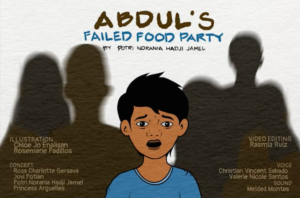
Abdul’s Party

Fiction by | August 15, 2022

Abdul was sitting in the military truck, looking at the cake being stepped on by different feet,  but none from a woman in black slippers. Red, blue, yellow, white, and finally, black slippers! He excitedly raised his gaze only to see a stranger. He disappointedly looked down and started searching again.
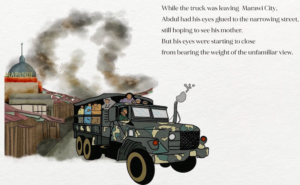
Abdul was waiting for his mother, who had gone back to their stall to get the bag that contained their earnings for the day, but it has been half an hour since.

“Boom!”

“Crack!”

The exchange of bullets had been nearing their area, so the driver decided to start the engine, causing Abdul to panic.

“Please, Bapa, Ina is not yet here. She will be here soon, so let’s wait for her. Please,” Abdul cried. The people in the truck looked at him in pity, but they knew they didn’t have a choice but to leave.

While the truck was leaving Marawi City, Abdul had his eyes glued to the narrowing street, still hoping to see his mother. But his eyes were starting to close from bearing the weight of the unfamiliar view.


When he woke up, Abdul found himself covered in a blanket and feeling the tears that dried on his face. He folded the blanket before going out of the room. He heard on television the news announcing the war between the terrorist group and the military.

“Abdul, you’re awake. How are you?” Bapa Ibrahim asked while watching the news.

“Bapa, have they found Ina?” Abdul asked.

“Your Bapa Saber and Bapa Taleb went back to look for her. You can join your cousin Mahdi first; they will play outside.”

Abdul looked outside the window to see kids running. He nodded to his uncle and followed them. When they arrived at a compound, the kids pulled pebbles out from their pockets and shot them into the empty sky. Since it is forbidden in Islam to hurt animals, they made sure to go to places that could cause less danger— few people around and almost no birds they could hit.

“Do you want to try?” Mahdi asked Abdul. Abdul only smiled and observed the pebbles falling from the sky, waiting to drop on an unknown target. He found the scene amusing and terrifying at the same time: amused by how the pebbles opposed the rising motion and terrified by their impact.

When Abdul had enough of the scene, he bid goodbye. He knew he was in Saguiaran, a municipality that was about nine kilometers away from Marawi City, because he had been here a few times. When Abdul slipped his hands into his pocket, he remembered the change from the cake he had bought for his mom. The chocolate cake he excitedly ordered to surprise her. The last time they ate a cake was at Aunt Jamalia’s wedding, where his mom finished almost four slices. That was also the first time he saw his mom enjoy food, so he made sure to save money for it.
He went straight to the convenience store and counted how much money he had. Although he only finished 3rd grade because of his father’s death, Abdul could do basic arithmetic faster than the other kids. With only 28 pesos left, he thought of what to buy that could feed his uncle’s family and his mom when she finally returned.

He decided to buy three packs of instant chicken noodles. He lacked two pesos, but the storekeeper was kind enough to let him have the noodles. Abdul smiled and thanked the woman before leaving.

It was sunset prayer so Abdul hurried to go back home. He was hungry and couldn’t wait to share the hot  soup with his cousins.  When he was near the house, he heard his Bapa Ibrahim fighting with his Aunt Fatima.

“Ramadhan is coming. How are we going to feed another mouth?” Aunt Fatima asked.

Astagfirullah, Fatima. How can you say that? His mother is not here,” Bapa Ibrahim answered.

“That’s my point. Why would his mother go back knowing how dangerous it was?”

“Because even if the bombs and bullets do not kill them, starvation will.”

Abdul listened from outside the house and cried silently. He was going to leave again for a while to pray at the mosque when he saw his Bapa Saber and Bapa Taleb running towards his direction. Abdul followed them as they entered the house and listened silently in the corner.

“How’s the situation there?” Bapa Ibrahim asked.

“It’s getting worse. No one can enter the city anymore,” Bapa Taleb answered.

“But a soldier gave us things they were able to retrieve,” Bapa Saber added before he looked at Abdul.

“Where’s Nihaya?” Bapa Ibrahim asked, which made Abdul attentive, hearing his mother’s name.

“We don’t know. I told you, we couldn’t enter the city.”

“What did you get then?” Bapa Ibrahim raised his voice.

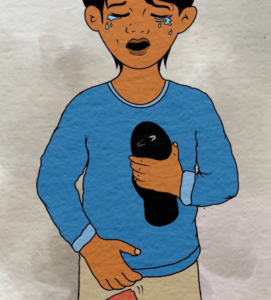
Bapa Saber took out a familiar bag. “We retrieved the bag that contained their money. And this,” he pulled out a black slipper. “We asked the soldiers if they had seen the owner, but no one entertained us.”

Everyone was silent for a while before Bapa Ibrahim stood.

“Let us pray first, Abdul. Then we will talk again,” Bapa Ibrahim assured him. As everyone left the living room, Abdul took the slipper and flipped it. He saw the safety pin that his mother had secured on the strap so it wouldn’t be detached from the hole. He wept again.

“Ina, please,” he whispered. “Please come back. I brought home some food.” He cried until he lost his grip on the packs of noodles and they fell to the floor.

Ihdinas siraatal mustaqeem, siraatal ladheena an ‘amta’ alaihim, ghairil maghduubi’ alaihim waladaaleen.

(Guide us to the straight path, the path of those who have received your grace; not of those who have evoked [Your] anger or of those who are astray.)

______________

Potri Norania Hadji Jamel, 21,  is a Meranaw student completing a BA English (Creative Writing) degree in UP Mindanao. An animated version of this story produced by CW 150 Writing for Children students  can be found in this YouTube link: https://youtu.be/GA-Rpyadpgc