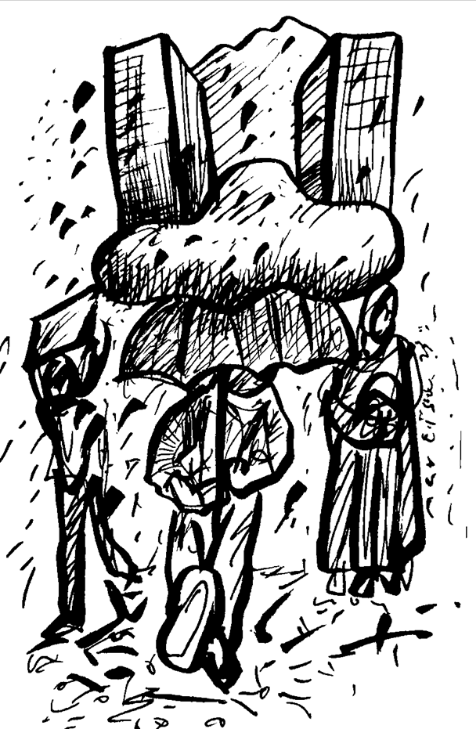
Every time the townspeople heard about the bridge of the Hijo River nearly getting destroyed after a night of heavy rain, they would always say that the golden ship of Maria Cacao passed by again to deliver her harvest. People living on the riverbank would even swear having heard its horn or seen its dazzling light in the middle of a dark storm.
It was early in the morning when people gathered around the edge of the Gaudencio Antonio bridge that almost collapsed. The old structure made from bamboo poles hadn’t been renovated for years. The passing of time and harsh weather conditions had left its sections crumbling and weakened. Most of the time, people in our sitio would just overlay the frail parts with new poles. I remember when Mang Torio accidentally fell his right leg into a hole while walking on the bridge.
The storm last night had left the other side of the bridge in tatters, its beams cracked and splintered. Pieces of bamboo were scattered across the river, revealing the extent of the damage. Some were busy plucking the floating coconuts while others were putting them inside the sacks. Inay told me to sweep the bamboo leaves the strong wind had blown last night, but I saw my friends having fun with the fallen coconut palms so I decided to come down. We were living uphill from the river, and this was the only bridge connecting us to the nearby sitio. It would take hours to reach the center as we were the last sitio of this barangay.
“It was huge and was so shiny!” Mang Torio said, extending his arms. I stopped when my slippers got heavier with each step. I rubbed them against the rock I found on the side, trying to get rid of the dirt. The ground was wet, and the grasses were blanketed with mud. Looking around, I saw Tiya Amalia, Mang Torio’s wife, wiping their floor and squeezing water into the pail from the rags. Fortunately, the flood didn’t rise high enough and entered our house.
“But I got chills and closed the window immediately,” he added. Mang Torio’s voice faded as I passed him from where he stood.
The story of Maria Cacao wasn’t new to us. She was a fairy who was known to kidnap people to keep as her servants if she found them out at night. In other stories, she disguised herself as an agent to get workers for her huge cacao plantation on the mountain and kept them there for a long time. Lolo Elias even told me a story of how his friend got out of Maria Cacao’s realm after he complained that the food was bland. It happened that Maria Cacao despised salt and so she let him go. But if she liked you, she would fool your family into thinking that you were dead by sending them a piece of a banana trunk. However, some would say she was a generous fairy because anyone who wished to use her utensils and silverware could ask for them at the mouth of the cave. The next day, without fail, these things would be delivered to your door. In some versions of the tale, she was even known to host parties with other encantadas in her golden ship where they would watch the destruction of the local bridge as they passed it. Stories also had it that she was a militant leader of an enchanted naval army who bombed the local river bridge, which had been constructed through the forced labor of Filipinos by the colonizers.
“Gabriela, get the oil at the altar,” Lolo Elias said. Today was Sunday and unlike the other days, only three patients were waiting to be treated. I immediately recognized their faces for they had been here before. I handed lolo a small bottle that contained roots and some dark liquid which seemed to be the oil that he’d made the other day.
“It’s been three days,” the first patient said, “the dots spread on her body even more and she could hardly move.” The woman in her mid-thirties almost cried. I supposed they were from another sitio on the other side of the river before us.
“Come back here tomorrow, and bring her to me,” lolo said, staring at the small crystal ball beside Sto. Niño. He shook his head while popping his tongue.
Lolo Elias was a known faith healer in our sitio who followed his father, my great-grandfather who died a couple of years ago. Lolo could heal snake and insect bites or people who had been hexed, and he could even communicate with spirits. Some patients even traveled from afar just to consult him about their illnesses. However, beyond 5:00 p.m. lolo would no longer accept patients. Perhaps people preferred him over hospitals since he would not ask for anything in return. Most of the time people would just leave offerings on the altar, like food or coins.
“Gabri, when is your pasukan?” Inay said, placing the plates in front of me. We were at the table and were about to have dinner. As it began to get dark, lolo positioned the gasera in the center and sat beside Inay. I looked at the vacant seat next to me, Itay hadn’t been home yet. It had been two weeks since the strike started, and he led the protest at the banana plantation. He had barely gone home since then.
“First week of August, nay,” I said. I was going to be in grade seven next enrollment, and the classes would begin in a month, but I didn’t have my notebooks yet and had no plans to buy them anytime soon. What Inay earned from selling banana cue was enough for us to get by every day. Itay could hardly provide food because of what they were dealing with at the plantation.
“I washed your old bag, just use it in the meantime,” she said. I nodded and continued to eat in silence.
*
The next morning, Itay came back home. His shirt now looked too big for him than the last time I saw him, and his pants and feet were dirty. Below his eyes were dark bags that seemed to be weighing heavily on his tired face.
“Mano po, tay” I said. I held his rough hand and put it on my forehead. He smiled weakly at me and took something out from his ragged backpack.
“We’ll buy you more when things settle at work,” he said. Itay handed me a red sando bag. The smell of new notebooks made my face light up as soon as I removed them from the cellophane. I wondered how he got the money to buy these, but I didn’t want to burden him with my curiosity. Perhaps he did a sideline job today.
“What’s that?” Inay said. She approached us from behind with a ladle in her hand. I could smell the aroma of ginisang Kangkong that she was cooking for our breakfast.
“I passed by a store that sells cheap notebooks earlier, so I bought some,” Itay said. He hung his bag on the protruding nail behind the door and went straight to the kitchen.
Inay asked me to help lolo in gathering Guyabano leaves from the backyard so we could have breakfast together. I quickly placed the notebooks on top of the cabinet and headed outside. Each day, Lolo Elias would boil Guyabano leaves to use as his drinking water. He believed it would cure his diabetes since it kept his sugar low.
“We were encouraging the workers from the other branches to join us,” Itay said. Everyone had finished eating except for him.
“Shouldn’t you stop now, Jaime?” Inay said worriedly. She was washing the dishes while I was at the table peeling the bananas that we would sell later. Itay was beside me eating like it was his first meal of the day.
“It’s too late,” he said, “and besides, some of the company board members seemed to be listening to us.” He drank water and stood up to get more rice.
“Do they really care?” Inay said, “Gabriela’s classes are about to start.” She wiped her hands with a towel and stood in front of Itay.
“If I stop, we’ll starve to death with the little salary they will give,” Itay said. “If we don’t take action now, they’ll think that it’s okay for us to be treated this way.” He placed his plates in the sink and washed his hands.
“Then we’ll move to Leyte,” she said. “We can stay in mama’s house in the meantime, and I know you can find work there.” Inay had been suggesting that for weeks. She wanted us to start a new life in Leyte and leave this place behind, but Itay was hesitant.
“Our life is here, Caridad,” Itay said, facing Inay.
“I just think that we’ll have more opportunities there,” she said. “Especially now that the plantation is not paying us right and Gabriela will go to high school.”
Inay was born in Leyte. At times, she would tell me stories of the beautiful places and how her life back there. The lush green mountains overlooked crystal clear waters, where they used to play as a kid. When her father, my lolo, had a stroke, she had to support her other two younger siblings. After she finished high school, she moved to Tagum with her two cousins to work. They found a job at a banana chip factory, and she met Itay during her time there. When they had me, Inay quit working. Itay took responsibility and decided to settle down here.
“Don’t worry, someone is willing to help us to file a complaint in…DO? DOL? If they still continue to ignore us,” he added.
“File a complaint? Isn’t that dangerous?” Inay said. “And we don’t have money for that.”
*
The following week, more people than expected came to see Lolo Elias. Even Tiya Amalia, who lived downhill and was the first in line, appeared distressed. Some were from other sitios who arrived early and stood patiently on the side. I arranged all the chairs we had, but there weren’t enough for everyone.
“Nong, Torio hasn’t gone home for days now,” Tiya Amalia said. “I last saw him when he was taking a bath in the river before heading downtown to work.”
“Wasn’t he on the plantation to protest with Jaime?” lolo asked.
“He was, but we need to survive,” she said, sobbing. “Please help me, nong. I brought his dirty shirt with me.”
Lolo took the shirt from her hands and closed his eyes. When he was done, he looked at his crystal and tilted his head. “It seems like someone purposely leads him astray, he needs our help.”
Tiya Amalia covered her mouth with her hands, tears started to fall from her eyes. “Who?” she said. “Was it…her, nong?”
Lolo tightened his lips and glanced sideways. He then told Tiya Amalia to come back tomorrow with three black candles and a chicken as a sacrifice. It took the whole day to assist most of them with their problems. At nearly five in the afternoon, lolo told the rest to come back the next day since he ran out of oil.
“Could this be the same thing that happened years ago, pa?” Inay said. She was helping lolo scrape the coconut meat while I was pouring the oil into the bottles. We were making the traditional banyos that Lolo’s father had passed on to him.
“We haven’t found bodies yet, I hope it’s not.” Lolo sighed heavily.
“But Mang Torio saw her golden ship,” Inay said.
Years ago, when Itay was my age, a lot of people also came to his lolo asking for help because their husbands had gone missing. Based on the story that had now become a legend in our sitio, there was a typhoon at that time, and while the rain was pouring in torrents, Maria Cacao’s golden ship passed in the Hijo River. In the days that followed, one by one the bodies of a group of men who’d worked for the banana plantation were discovered floating in the river. However, when my great-grandfather performed a ritual during the wake of one of the victims, everyone was taken aback to find out that the body was nothing more than banana trunks. Until today they hadn’t returned yet and some had said that they had been taken to work at Maria Cacao’s plantation or were still in her ship to deliver the harvest. The families of those victims believed that Maria Cacao had taken them, while others said those men had been involved in the robbery at the plantation so the owner hired a gunman to clean up the mess. But the truth behind the mysterious disappearances remained shrouded in rumors and speculation.
*
Tiya Amalia came back the next day. She brought the things that were needed to perform the ritual that Lolo Elias would do in the river.
“Is your habak with you?” Inay said. She told me to go with lolo and helped him go down the hill because the route was slippery.
“Yes, nay,” I said, looking at the band I had tied around my belly. Ever since I was a baby, I had always worn it as protection from the dili-ingon-nato entities.
A strong wind chilled my spine as we approached the river. The big stones along the water’s edge glistened in the rays of sunlight, casting shivering shadows across the surface of the water. At a closer look, the body of the river appeared wider than one could see from above the hill. Various plants and trees lined its banks, their branches reaching out towards the water as if yearning to touch it. I could see the bridge in the distance. It wasn’t broken anymore; the braces were replaced with young and sturdy bamboo poles.
I could feel my heart pounding in my chest as we prepared to get on the descent down the river. I went down first and held lolo’s hand tightly, assisting him every step of the way. Tiya Amalia followed us to a more secluded place where we could put the candles on a big flat stone. When we arrived, I jumped in surprise when a frog landed on my feet with a soft plop. I had been accompanying lolo ever since but every time we had to do it, I felt nervous. I took a deep breath trying to calm myself. The sky was clear, and the water was calm; the silence was so loud. This section of the river was so remote that even if I screamed, no one would even hear. I laid the eco-bag containing the match, knife, and guava leaves on the ground.
“Lit the candles and don’t let them die,” Lolo Elias said.
I gave the match to Tiya Amalia and helped her protect the candlelight from the wind.
Lolo Elias then took the guava leaves and kneeled in front of the river. He closed his eyes and prayed in a language that I didn’t understand while waving the leaves in the air. The cool wind brushed our skin, the water became uneasy, and the grass seemed to dance along with the rhythm of the prayers.
After a few minutes, Lolo Elias stood up and signaled to Tiya Amalia to bring him the chicken. I covered the candle’s faint glow on my own, but the gusts of wind kept threatening to snuff them out.
From where I stood, I watched intently as Lolo Elias took the chicken from Tiya Amalia’s hands and began his ritual. Tiya Amalia held the chicken by its wings and legs tightly while Lolo gripped the head to find its neck and then he slashed it with a knife. He was murmuring words that I couldn’t quite make out. As the words flowed from Lolo Elias’ lips, I noticed a sense of reverence in his demeanor. The chicken screeched in fear. I slightly turned my head sideways, trying not to see. The sound of the knife against the chicken’s flesh competed with the foul’s shrieking. Goosebumps ran over my skin. The blood from the chicken’s neck dropped into the river and flowed down with the water.
“A life has been taken, another one must come.
The blood may travel to your land and guide the lost lamb.
A life has been taken, another one must come.
The blood may travel to your land and guide the lost lamb.”
Lolo started chanting repeatedly until there were no drops of blood left and prayers remaining unsaid.
*
The same day, Itay returned home earlier than expected. When he walked over to me, his face was bright and unruffled, unlike before. The corners of his mouth turned upwards, revealing the fine lines of wrinkles in his eyes.
“That’s your favorite balolong, Gabri,” Itay said, patting my hair. He handed me a crumpled brown paper bag and headed inside the house. As I opened it, the aroma of newly baked garlic bread awoke my hungry stomach. I followed him into the kitchen where Inay was cooking law-oy for lunch.
“I was called into the office earlier, and management promised to pay us the minimum wage beginning this month!” Itay said. He was almost in tears as he told Inay about what had happened.
I couldn’t help but smile. Finally, our lives would be back to the way it used to be. I didn’t have to stress myself about school and Inay would no longer sleep late waiting for Itay to come home safely.
“That simple?” Inay said. “I thought they’ll ignore us until we give up.”
“Maybe they’re really scared that I’ll report them to Labor,” Itay said.
“Let’s hope they won’t take it back like the other promises they made before,” Inay said. She sounded worried but her eyes showed that she was relieved to hear the good news.
*
The next morning, the aroma of the simmering chicken and spices filled the air, tempting me to leave my bed. That day, Itay did not work and decided to make amends for the past weeks that he wasn’t home. He woke up early and cooked tenola with lolo’s native chicken.
“Let’s eat!” he said. He served us each a bowl of tenola. The steam rising from the bowl warmed my face, and I couldn’t wait to dig in. We both liked chicken liver, but he saved the whole piece just for me. It was the first time in a while that I had a nice breakfast. Though I wasn’t sure whether lolo knew it was his chicken. He enjoyed the food, so I assumed that he did.
“Gabriela, come here,” Itay said.“Can you disentangle this?” he said, pointing the fishing net on the ground. Itay was on the balcony sitting on the wooden bench while fixing the fishing rod. The old fishing net that he used to catch fish was clasped together. The stones tied to the bottom of the net had messed with the holes. Some parts had been worn and weathered. I wondered if this could still catch fish, maybe the big ones.
“You’ll go fishing, tay?” I said, untwining the ropes. Itay used to go fishing during weekends on the west side of the Hijo River where the water was calm and teeming with fish. At times, I would go with him and catch Guppies that I would treat as a pet for days.
“Yes. Do you want to come?” he said. He stood and helped me with the fishing net.
I nodded excitedly. As soon as we finished, he gave me the fishing rod while he took the pale and other things that we needed. When we were about to go, Inay reminded me not to make noises on our way so I wouldn’t disturb any spirits.
We left the house and started walking down the hill leading to the river’s edge. We walked carefully through the dense trail toward the fishing spot. Itay’s hilarious riddles along the way had me all the time. As we reached the riverbank, he began setting up his fishing net while I cast my line. I watched eagerly as he expertly spread the net and came down the water.
“Tay, I think I got a big one!” I said, struggling to stay in place. “It’s so heavy.”
“Hold on!” he said. Itay rushed to me. He put his hands over mine and helped me pull the rod. The fish seemed to be running around the water as the line was moving in directions. Seconds later, we both laughed as we saw that it was nothing but a little fish.
I got tired of waiting for fish to eat my bait, so I decided to run after the baby fish in the shallow part of the water. While Itay was busy catching fish that we would have for dinner later. Luckily, I got two of them and secured them in a plastic bottle. It was passed noon when we decided to go home. The sun was still shining brightly, casting a glow over the water.
When we arrived home, I transferred the guppies to the old glass jar that used to be a flower vase on the altar. Lolo Elias volunteered to cook the fish that Itay caught since there weren’t many patients that went on that day.
We spent the rest of the day helping Itay cut the hay in the yard. As the sun set and the night sky crept in, Itay laid out a mat on the floor. I walked on his back like I used to until we both fell asleep. I missed those moments with Itay when we were happy and complete. But just when I thought everything was going to be normal again, things took a turn for the worse.
*
Three days later, Itay didn’t return home. He didn’t say anything or act as if there was a problem before leaving the house for work the day he disappeared. He didn’t bring clothes or anything that he could use if he planned to stay somewhere for days. Inay knew that he didn’t have much money either when left. We had no idea where he was. At first, Inay thought that maybe there was a problem in the plantation, and they needed to stay overtime, but it had been three days, and no one, not even his coworkers, knew where he was.
People’s speculations grew stronger as the days passed. Our neighbor said they saw Itay recently buying fish at the downtown market. Some also swore to have seen him in another barangay, working in another plantation. But everyone seemed to conclude that Itay had been taken by Maria Cacao after someone saw him walking alone on the bridge late at night. They claimed to have called his name, but he did not respond.
Lolo Elias even performed the same ritual we did in the river to find Itay but until now, he hadn’t returned home yet. Inay hadn’t been sleeping since then. I could barely talk to her since she was always in bed, crying.
“There is a body floating in the river!” I heard the neighbor’s shocked voice echo through the small neighborhood. Everyone was rushing down the river to see who it was. I immediately put on my slippers and left my dishes unfinished. Since Itay had gone, I’d been doing most of the housework except for cooking other than rice.
I hurried to the riverbank where a small crowd had already gathered. Thoughts of Itay’s body floating in the river were in my head. My heartbeat was fast, I had difficulty gasping for air, and my hands were shaking. I was having second thoughts about going closer when I heard Tiya Amalia’s cries. Pushing through the crowd, I caught sight of the lifeless figure on the ground.
“Who did this to you?!” Tiya Amalia cried, hugging his body.
The body of Mang Torio had been found floating face-down in the river, lifeless and motionless. His face was almost unrecognizable from the bruises and cuts that covered it. His body was already starting to bloat and decay in the water. People tried to pull Tiya Amalia from the body that had begun to rot, but she wouldn’t let go.
I couldn’t believe what I was seeing, and the shock of it all left me feeling numb. I heard people whispering among themselves, speculating about what might have happened. I stepped backward and ran home. I thought of Itay. I couldn’t help but feel a wave of sadness and unease. Did Maria Cacao really take him? Would she also return him lifeless when he was no longer useful to her? But Itay was hard working, I knew that Maria Cacao would like him enough to keep him.
*
After almost a year of waiting for Itay to come home, Inay decided that we both move to Leyte, leaving Lolo Elias behind. As he refused to come with us, saying he’d continue to help people with their illnesses. Fortunately, a cousin from Itay’s family side agreed to stay with him in the house and assist him with his needs.
I was still hesitant at first because apart from wanting to be in the house if ever Itay returned, I knew I would miss lolo a lot. He just turned fifty-nine a few months ago and I felt bad leaving him as he seemed to be getting more forgetful each day.
“Take care, lo ha,” I said. “I’ll text or call you. Always take your phone with you.”
“Don’t worry, Gabriela. We’ll see each other again,” he said, laughing softly.
*
During my school vacation break, Inay and I traveled to Leyte. I met all our relatives from her side whom I had seen for the first time. We stayed in my grandmother, Lola Pasita’s house since she was living there alone. Inay’s two other siblings already had a family of their own and lived in other barangays. Sometimes, they would visit us or the other way around.
“You look as beautiful as your mother, Gabriela,” Lola Pasita said. She smiled at me, and I could vividly see Inay’s uncanny resemblance with her even with her age. She welcomed us with open arms, and I could tell that she was excited to have us there.
Inay and lola were catching up in the living room while I looked around. The house was kind of different from ours back in Tagum. The design was that of a traditional Filipino house, with its wooden beams and capiz windows. Though there were evident signs of years of wear and tear, making the house seem weathered, it still exuded a sense of warmth and coziness.
“I’m glad you’re back for good,” Lola Pasita said. I was on the balcony looking at her flower garden, but I could hear their voices and giggles through the window. For the first time after what had happened to us, I finally heard Inay’s genuine laugh again. It was as if a heavy weight had been lifted off her shoulders, and I couldn’t help but feel relieved.
“I already prepared your room,” Lola said. “Bring your things in so we could have a merienda afterward.”
*
“How are you, lo?” I spoke. Lolo Elias would occasionally call or text me, so I didn’t really feel like he was miles away.
“I am okay now,” he said. Through the years, he grew weak. His diabetes worsened but didn’t want to go to the hospital. He told us that it was just a waste of money, and he had his own ways to cure himself.
“Don’t forget to drink your medicine,” I said. We talked a little before ending the call as he wanted to sleep.
After all, I could say that it was a good decision that we moved to Leyte. Lola Pasita helped Inay to have a small sari-sari store in the house to support our needs, especially my studies. I met my cousins and went to school with them. Every weekend, they would invite me to their houses for a sleepover and spend hours playing card games or telling each other stories. I had also the most unforgettable high school experiences. First on the list was when I had my first ever heartache with my ex-boyfriend. My grades dropped drastically after it, so I didn’t try to have another one. I also made a lot of friends. I would join my classmates and have fun with them every after class. At times, we would go to beaches and have a picnic or adventure in the mountains, which Inay knew as school activities. There was even a time when we went fishing in the nearby river and I remembered Itay. What my life could have been if he hadn’t disappeared? Would I regret not going here in Leyte? I felt bad not thinking about him that much anymore, but I realized life had its own way of healing our wounds and helping us move forward.
“You’re late again,” Inay said. “Gabriela, are you really studying?”
“I told you this morning that I’ll have to attend a webinar at school after class,” I said. Now that I was a junior in college, I stayed out more than usual. Sometimes to drink out with friends but most of the time, to do stuff in the organization that I was part of. I was also dealing with someone special, but it was not that serious yet.
“Make sure that it is really school,” she said. “Think about what your father would say if he saw you.”
“He wouldn’t anyway,” I whispered to myself. Every moment like this, Inay would always bring Itay to the conversation. Honestly, I grew tired of it. Sometimes, I would think that no one really took him, he left us, but I felt sorry for Inay. After all these years, I knew she was still waiting. I would see her sitting on the balcony late at night, looking in the distance. Every time I asked her, she would simply say that it was just an old habit.
*
“Gabri, have you finished packing your clothes?” Inay said.
Lolo was rushed to the hospital last night. He collapsed while trying to make the oil he used for healing. He had been feeling weak and dizzy for a few days but didn’t think it was anything serious. The doctor told us that his diabetes had caused a major complication in his heart, and we needed to prepare for the worst for the next twenty-four hours. So, we decided to return home for the first time since we first moved to Leyte before it was too late.
“Yes, nay,” I said. I zippered my hand-carry luggage and put it on the floor near the door. It had been almost a decade and a part of me wanted to see what our sitio looked like now or if our neighbors were still there.
It was 1:00 p.m. when we reached the terminal. After we purchased tickets at the ticketing counter, we sat on the waiting chair. Our scheduled ferry going to Butuan was expected to arrive in a few minutes. While waiting, a nostalgic feeling came over me. The bustling surroundings with passengers busy boarding and disembarking, others checking in luggage and boarding passes, and some browsing shops and restaurants reminded me of the first time when I was here. I wondered if our sitio hadn’t changed much either.
“Let’s go, Gabri,” Inay said. After the security checks, we were directed to the entrance of the ferry, an employee verified our tickets and allowed us inside. We put our bags on the other side and chose our seats. There weren’t too many passengers, unlike the last time I was here.
After we had dinner in a self-service cafeteria, I decided to sleep so I would have enough energy tomorrow when we arrived.
“Gabriela…” I woke up to the voice of Itay calling my name.
“Tay?” I mumbled in reply. Everything was dark except for the open door in front of my bed.
“It’s time to wake up,” he said, his voice filled with excitement and urgency.
Inay changed her sleeping position, her movements woke me up. I yawned and pulled the covers off my head. I rubbed my eyes and realized that it was one of those dreams again. I hadn’t had this dream for a long time. Perhaps, it triggered my memory because we were traveling back to our sitio. I sat up, allowing the remnants of the dream to fade away. Stretching my arms, I glanced at the clock and realized it was still three in the morning. I looked around, the waves of the sea, and the sound of the engine gave music to the place. I stood up to find the comfort room.
The static noise from the TV on the wall filled the area near the CR. I thought of turning it off after I peed, but when I came out of the cubicle, my eyes were greeted by dazzling light. I covered my face with my hands and walked to the side to see what happened. I was confused, everything wasn’t how it looked earlier. The old blue walls became glass with intricate gold designs. The old lightbulbs were replaced with big chandeliers hanging from the ceiling illuminating the entire place. The big tables with fancy silverware were laid out for dining. There were waiters serving food and wine, but no one was seated at any of the tables. Maybe there was a party that hadn’t started yet? I thought to myself.
I looked around, trying to figure out if I entered the wrong room, but I couldn’t find a door—not even the door of the cubicle I came from. A familiar sight caught my eye from the window to my right. We were about to cross a bridge. I got goosebumps and my heart started racing. I moved in closer to see where I was. I froze in place, hands over my mouth.
“Hijo River?” I said to myself. I turned around, this grand place wasn’t the ferry anymore. I tried to approach the waiters, but they only continued to serve as though they didn’t hear me.
I called Inay countless times while running around, but no one answered until I bumped into someone. The first thing I noticed was her long white dress. It was flowing down to the floor and was made of a light, delicate fabric that seemed to shimmer in the sunlight. As I looked at her, her long hair flowed down covering the thin straps of the gown crossing over her shoulders.
“Who…are you?” I spoke. Even though at the back of my mind, I always knew who she was.
She didn’t bother to respond. She walked straight to the longest table and sat in the middle. She then looked at me, her eyes were speaking, wanting me to sit down.
Every nerve in my body wanted me to follow her. I took a seat in front of her. She looked so pure, her face was merciful, and her actions were soft. She then held out her hand and offered the food in front of us.
I slowly took the food on my plate, but just as I was about to take a bite, someone grabbed my hand.
“I have been looking for you,” Inay said, yawning.
I looked around and saw that I had been standing in front of the cubicle the entire time. I sighed heavily as if I had been holding my breath for a long time. I hugged her, I couldn’t imagine what would have happened to me if Inay hadn’t come.
“Are you okay?” she said. She furrowed her brows and faced me. I shook my head and smiled weakly.
*
In the morning our ferry embarked at the Butuan terminal. After we had breakfast at a small cafe near the port, we headed to the bus stop to catch the bus going to Tagum. As we boarded, Inay told me that I should sleep again so that I would feel refreshed when we arrived. The bus ride was long, but after what had happened earlier, I couldn’t get back to sleep anymore. I was still in disbelief, in awe of what I’d seen.
It was 11:00 am when we finally reached Tagum, the sun was high in the sky. We decided to have lunch at home since it wouldn’t take long to arrive at our sitio. While we were on the tricycle, Itay’s cousin who was with Lolo Elias in the hospital called me.
“Nay, Lolo Elias passed away,” I said. “They said we’ll go straight to the morgue later.” My heart sank as I said those words to her after the call. I could feel the weight of sorrow settling in. Inay was in utter shock and sadness, with eyes filled with disbelief. We knew it would happen anytime soon, but I thought I could still see him alive once again.
The tricycle came to a halt when we were at the bridge’s mouth. People were gathering around. The driver got off and asked someone in the crowd. He then returned and told us that we couldn’t cross because the bridge was broken. If we want, we could ride a bamboo raft to reach the other side.
“What a coincidence! the bridge was broken on the day we returned,” Inay said. She handed our fare to the tricycle driver. I helped her take out our bags and stood on the side of the road, not far from the people.
“Caridad, is that you?” A woman who had now a slightly hunched back and wrinkles etched across her face approached us. Inay and I both recognized her face right away.
“Amalia! How long has it been since we last saw each other,” Inay said.
Tiya Amalia put her bayong down and stood closer to us. “You look nothing like the last time I saw you here, Gabriela,” she said. I couldn’t help but chuckle at her comment.
They then turned to each other, catching up on the things that had occurred in our Sitio for the years that we weren’t here.
“By the way, why is the bridge broken again?” Inay said, looking at the bridge behind us.
“Hay, it was really hot here yesterday but suddenly it rained around midnight,” Tiya Amalia said. “It rained so hard that it must have damaged the bridge.”
“After all these years, the barangay hasn’t fixed this problem?”
“I heard this time they’re going to replace it with metal.”
They continued to talk about some other things while I was busy catching a signal on my phone to call Itay’s cousin and tell him about Lolo Elias.
“I almost forgot, it’s good that you’re here so you can give your testimony against the plantation,” she said.
“Testimony about what?” Inay asked.
“The plantation is facing multiple murder charges, including the murder of my husband. You didn’t know?”
I was stunned. My mind turned blank as the reality of the situation sank in. I looked at Inay, her tear-streaked face revealed the truth I was desperately trying to deny. Itay had been murdered, a chilling moment of realization. He was not taken by some entities, and on top of that, he didn’t leave us. The shock and sorrow overwhelmed me as I tried to comprehend everything.
I went closer to the bridge. Its weathered wooden planks creaked under my weight as I stood on it, feeling the soft sway of the bamboo beneath me. My hands gripped the rails, looking at the Hijo River. The water was calm and serene, gliding peacefully over smooth rocks and reflecting the vibrant colors of the surrounding trees. A stark contrast to the windy and stormy emotions I was feeling. Tears were streaming down my face.
“I’ll fight for your justice, just as you fought for us, tay,” I said.
Calmness filled the air, but the pressing feelings I felt were bigger than the river, bigger than stones, bigger than the ferry, big and heavy of all.
***
Diane Pearl O. Templado is a third-year BA English (Creative Writing) student at the University of the Philippines Mindanao. She believes in reincarnation and wants to be a bird in her next life.