Ode to the Uterus (and those who own them)

Poetry by | August 7, 2023

My uterus is raging, ready to burst
in red. The pain runs through
my hips, my thighs, my legs
leaving me in fetal position
alone to clutch the smallness
of my stomach that clenches in ache.
It is angry, it demands, it throbs like
a beating heart—alive and enduring.
I persist like a banged-up drum
and dare to brave the torment that tries
to beat me down.

I will not succumb
nor will I surrender. I am persevering and
resisting like the uterus in anger.


Daryll Faye Gayatin is from Isulan, Sultan Kudarat. She is a BA English (Creative Writing) student at the University of the Philippines Mindanao.

I Get To

Nonfiction by | August 7, 2023

I am afraid of the baby waking up. I am afraid that the baby won’t wake up. I have been afraid of a lot of things since I gave birth to my son.

I spend the whole day with my baby and my second child, D, alone. Day after day, I spend it dreaming of having some help around the house. I wish someone would spend the day with me, not to do the household chores, but to take care of my children, so that I can focus on my work. The mere thought of it makes me feel guilty. Am I a bad mother for secretly wishing I could spend a little less time with my kids?

I want to call my mother and ask her to come to our house. I want to tell her that I need her help, but I know I can’t. My 64-year-old mother has a limp and moving around with the baby is just impossible. I need my mother, but I don’t want a smoker around my kids. That’s the real reason why I don’t call her for help.

Maybe today wouldn’t be so bad. Maybe it wouldn’t feel so arduous having to take care of two kids while working a full-time job and doing household chores in between. At least, I get to it. I get through it and tomorrow is a different story.

I was in the middle of speaking to a client when I heard my daughter shouting. She was calling for me saying that the baby was awake and was crying because he wanted some milk. I had to apologize to my client for I needed to cut the call. I told him I’d call again as soon as I calm the baby down.

I get to the baby and lay down beside it for a good thirty minutes or so. Then we both got out of bed and walked to the playroom where we would spend the rest of our day playing, cuddling, working, and all of it all at once.

“What’s for lunch today, Mama?” D asked kindly.

“I don’t know,” I quietly replied. I have always been honest with D. Since she was young, I have always been open to her about a lot of things, something I taught myself to do. I wasn’t like that with my first child. This is me trying to unlearn things to be a better mother.

I honestly didn’t know what to feed my kids for lunch. My morning was spent juggling work and motherhood.

“What about breakfast for lunch?” D suggested.

“That sounds like a good plan,” I said with motherhood guilt slowly kicking in. I quietly walked away and prepared hotdogs to cook. I should be feeding D healthier food, but it’s the only thing I could think of at that time. I get to feed D with food and that’s enough for today.

Nighttime came and my eldest daughter L and my husband were home. I was excited to welcome them, thinking I can finally get my hands free from the baby, but they both looked exhausted. I don’t want to add to their burden. A part of me wants to say that I was burdened by the fact that I have to take care of the kids and earn a living. But I am the mother. Everyone expects me to take it all in.

And so, I get to the crying baby. I comforted him like the good mother that I am. Today, I chose my baby over the urge to let him cry until he gets tired. I am tired, so I cried while my baby was sleeping soundly in my arms.

We took the kids out last weekend. I bumped into an old classmate of mine and we exchanged smiles. She asked me where I was connected and I told her I was working from home. She told me she was still working with the same bank. She wished she could stay at home with her kids like I do. I just smiled.

It was the only thing acceptable at that time. I didn’t have the courage to tell her that I thought she was lucky to be away from home for a few of hours every day. I wouldn’t dare tell her how tiring it was to be with my kids the whole day everyday 24/7. So I smiled. Anyway, she didn’t ask me how I was doing. Nobody does.

I clean our floors more than three times a day. As my son crawls and D plays on the floor, I feel like I need to clean our floors as often as I could. The hair on the floor didn’t bother me before, but now, I can’t go on three hours without giving in to the compulsion to clean the floors.

A friend I haven’t spoken to in months asked me about my routine. She sent me a message telling me how incredibly amazing I was for being such a hands-on Mom. I told her how I get to things everyday. That started it all. I told her how frustrating it can be to teach D a simple math problem and she still ends up getting the wrong answer when asked to do it alone. I told her how angry I was that my husband can get to hang out with his friends while I am at home with the kids.

I went on telling her how no one in the house can get things done in ways that I consider right. And that no matter how seemingly important my concerns are, there is this baby whose needs will always be my priority. It is oppressive.

I realized I must have said too much because our chat fell quiet. She didn’t send any reply to anything that I said. It must have overwhelmed her.

I wished she has something, anything. I wanted to tell her about my good days as a stay-at-home mom too. I wanted to tell her how proud I was when L came home with a perfect score in her Elective Math quiz. When I congratulated her, she simply replied, “Thank you Mama for helping me.”

One of my proudest moments as a mom was when D was picked for the special dance. She was one of the few students in her ballet class that was in the Director’s List this year. Her teacher said she is showing a lot of promise. I came home smiling.

I was already 37 when I gave birth to my son, so I took special interest in his development. I read books about baby milestones and became nearly obsessed about whether my son was hitting it or not.

Imagine my happiness when he rolled to his tummy for the first time. Oh, I couldn’t stop talking about it that I actually annoyed the people around me. But I didn’t care. That was one of my proud mama moments.

I feel like I am capable of doing so little, but I am asked to do so much. Yet again, I have to remind myself of the mantra that has got me going all this time. I get to the crying baby, teach D how to read CVCs, assist L as she learns how to balance equations in Chemistry, and give my husband a massage after a day’s work.

I get to witness my children grow up and get to be there when they need me. I get to teach my daughters with what I think they need to know to survive the world while I teach myself how to survive my days. I get to mother this baby boy and show him how it is to love and be loved.

The next day, I do it all over again, only it’s not like I’m at war. It’s not as awful. It entails a lot of work, but days are no longer impossible. I get to experience all of motherhood and its quirks.

Little by little, I get to live.


Lysette lives in Davao City with her husband and 3 children. She is passionate about homeschooling.

In the Solitude of Wisteria Trees (Part 2)

Nonfiction by | July 31, 2023

In that moment, I just listened.

I stopped in front of one of the trees, taking in all the details. Its imposing trunk stood far behind a low fence. Lines and grooves ran across the dark brown bark and revealed its age. The healthy branches stretched towards different directions, leading to the smaller vines and finally the blossoms.

It was a much bigger tree. But the fascination felt familiar.

As a child, I have always been fond of flowers and gardens. I spent many hours playing and picking apart the flowers in my grandmother’s yard in Davao.

I marveled at the fruits that grew from the trunk of her cacao tree. I admired the papaya tree fronds which reminded me of the tree star leaves in the 90s movie Land Before Time.

I would climb up the sprawling gumamela shrub that seemed like a tree to the tiny five-year-old me.  I nimbly made my way through the branches to pick blossoms.

I also plucked flowers from the santan bush next to it, and linked them to make garlands and bracelets to wear for the day. One of my cousins taught me how draw out nectar from them too.

I was a flower maiden in my own right. The garden was my playground. There were no toys in our ancestral home. There weren’t any children my age, well except for my sister. Though an aunt and my then-teenage cousins lived on the second floor, my usual babysitters did have their own lives and romps to attend to. If I was left there for the weekend afternoon, the garden was the escape.

I made the gumamela my toys, pretending they were flower folk with the petals as skirts and the stems as bodies. I imagined them to be like whimsical characters from the cartoons I watched. I built dialogues. I narrated. Perhaps the grownups never understood the narrative they overheard. Perhaps they never will. But it never really bothered me.

Exploring the garden was a pastime I enjoyed in solitude. It was a pastime buried under the other pastimes I discovered over the next years of my childhood, only to be unearthed when I moved to Japan. I would head out to gardens, get lost in thought, then snap away with my camera phone.  I followed the plum blossoms and camellias of early March, the cherry blossoms and baby blue eyes of April, and even the irises and hydrangeas of June. I didn’t mind the alone time. I guess my only problem was if there was a very scenic backdrop and I wished I could get a full-body picture with it.

Sumimasen! (Excuse me)” called a woman from behind, her voice laced with a Vietnamese accent. “Sasshin, torimashouka? (Shall I take your picture?)”

I came out of my meditation. I turned to see a group of travelers, some of whom were dressed to the nines. The offer came from the woman with a smile on her face and a camera on hand. “Hai, onegaishimasu (Yes, please),” I stuttered in surprise and handed my phone.  She toggled with it a little, took some photos, and gave it back. I took it as my sign to move on.

The clouds were slowly clearing up to reveal the rich indigo shade of twilight. I explored more of the wisteria groves the park boasted of. I discovered the double-flowered wisteria tree with puffy blossoms and filled the air with a delicate, floral scent. I saw the trellis of pink wisterias that trailed down like rain, its vines growing to nearly two meters long. Then I ended up in a slightly smaller but solitary trellis that was bathed in an ethereal purple light and invited another moment to contemplate.

The wisterias were all aglow as dusk slowly crept in. I walked to the park exit with a gallery full of whimsical trees. And a few pictures of me and hundred-year-old wisteria trees.


“In the pale moonlight
The scent of the wisteria
Comes from far away”
-Yosa Buson, In the Moonlight


Stephanie Puyod is an alumna of the BA Communication Arts program of the University of the Philippines-Mindanao.

one big wash

Poetry by | July 31, 2023

The machine brought to life by a soft ping,
You stare as your clothes begin to tumble
Into an array of vibrant hues spinning,
Water bubbling white you start to mumble
Nothing. No thing came to mind.
The soap was dwindling and you had no thoughts.
That frightened you, sitting down resigned
With nothing on your mind, just idle of sorts.

And yet as the machine spiraled into
Impossible speed, you laid back reclined.
The bubbles start to disappear and you
Stayed hypnotized by accelerated
Spinning garments. You’re okay with nothing.
And the machine sings back its final song.


Fatima Herizza D. Edding studies BA English (Creative Writing) at the University of the Philippines Mindanao in Davao City. She prefers to be called Lady, her nickname since birth. She is from Zamboanga City, Zamboanga del Sur.

One Bed Apart

Poetry by | July 31, 2023

Mama and Papa now sleep in different
beds. “Your father snores,” Mama said.

Papa has been drinking a lot of sour juice
lately, his breath stinks when he tries to talk

to me. “If Mama and Papa have to live in
different houses, who would you live with?”

Papa asked before he fell asleep on the couch,
waiting for Mama to come home. As soon as

Mama got home, she told me to go to my room
and play with Chippy, the stuffed toy that they got me

for my seventh birthday. Mama interrupted
my little tea party when she knocked

on my door. “Papa snores louder now,
anak,” she said. Then she went outside the house

and went inside the green car that looked
a lot like my Ninong’s—he was Papa’s kumpare,

the one that he used to drink sour juice with.
I have never heard of Mama since then.


Reggie is taking up a Bachelor of Arts in English (Creative Writing) at the University of the Philippines Mindanao. She is a completer of the Special Program in Journalism and a graduate of the Humanities and Social Sciences of the Davao City National High School.

In the Solitude of Wisteria Trees (Part 1)

Nonfiction by | July 24, 2023

“Come join me in the regrets for the passing spring
And wisteria aglow in the evening light”
-Murasaki Shikibu, Tales of Genji


The sky was overcast from the afternoon rain. Gray but thankfully not too dreary. All that was left was a slight drizzle. Some of these raindrops have settled on my glasses, but I didn’t bother to brush them away.  I maneuvered my phone through the clusters of wisteria before me. My goal was to achieve a “peering through the vines” self-portrait.

Little by little I found my groove and my angle. I was pleased.

I was doing yet another hitori tabi—or solo traveling in Japanese—this time in Tochigi, a prefecture north of Tokyo. Since I moved to the Land of the anime and kawaii things in October 2017, I’ve slowly cultivated a tradition of chasing and documenting perennials. It began on my first spring here, when I chanced upon cherry blossom sightseeing maps at the train station. I sought to check out the accessible spots, and from there I was hooked. The following month, I was in the company of friends and roses. The next year I added hydrangeas and irises to this list. Yes, I travel for flowers.

Over the next years, I made it a goal to visit a wisteria garden—the ones that lead you through winding pink tunnels or expansive trellises. I finally ticked it off in April 2022.

Tochigi’s Ashikaga Flower Park is home to some of the largest and oldest wisteria trees in Japan. I came there in search of the famed hundred-year-old wisteria trees that were said to inspire the Tree of Life in James Cameron’s Avatar. To be honest, I’ve forgotten how it looked like, but I do remember being amazed by the gigantic tree with pink cascading vines and a soft glow about it.

The one before me wasn’t as majestic. Neither were the other ones in the grove I was in. These looked young but approachable. They allowed me to study the flowers up close.

The purple blossoms dribbled down the vines like droplets of water. They could easily fall off with one wrong move. Wisteria is known as fuji in Japan. (Similar but not to be mistaken for the mountain. Their kanji characters are different.) I find it amusing that the flower’s kanji is a combination of the symbols for grass and water rising. It put me in a glass-half-empty-half-full kind of quandary.

After all, the wisteria is also admired for its form, with its arched trunks and its blossoms facing downwards. It was as if the whole plant was deep in prayer. Fittingly, the flower is used in the crest of a branch of Buddhism in Japan, using it as a symbol of humility and reflection.

I pulled away from this grove and navigated my way to the center of the park. The afternoon light was waning. The night illuminations would begin soon. I stopped to take photos of yellow and orange poppies. Even the azaleas. A tall pergola of baby pink wisterias snaked around the courtyard. The cherry blossoms were long gone, but spring was still in full swing.

While cherry blossoms or the sakura is the first flower that come to mind whenever one speaks of Japan, wisteria have earned a place in the country’s history and art.

We can see these viny blossoms as a common motif in kimonos and ceramics. Fuji Musume or Wisteria Maiden has been a favorite theme in paintings. Much like the goddess Venus, this woman has been reinterpreted many times. It has also inspired a traditional dance which tells the sad tale of Fuji Musume that came to life, longing for man who viewed her painting. She walked around with a stalk of wisteria as she waited a reply to her love letters.

True enough, wisteria has a character that evokes longing and nostalgia. Perhaps it’s in the tranquil purples and blues mixed with whites and pinks. Perhaps it’s in the manner the flowers dangle and seemingly float midair. Or perhaps it’s in the melancholic way the vines droop, as if longing for a past that may either be happy or sad. In this light, wisteria has frequently been tied to nostalgia in Japanese literature.

The 11th century masterpiece Tale of Genji describes fuji as a companion to the sadness that comes in the passing of springtime. Author Murasaki Shikibu compares it to the snowlike sakura which, while beautiful, is fleeting in nature. The wisteria comes out at an opportune time, much later in April, sitting with observers to lament time gone by.

Taking my sweet time around the park, I followed another path of young wisteria shrubs. A mix of excitement and longing bubbled up in my chest. Then through a clearing, I finally saw it: a trellis more than a thousand meters wide.

Over it hung a curtain of lilac and purple flowers with the specks of royal and sky blue.  Bumblebees buzzed through the vines as if they too were on holiday. Underneath, people milled around with their eyes fixed on the blossoms overhead.

On opposite sides stood two grand wisteria trees. There was a sense of wisdom and strength told in the way they stooped down with the breadth and abundance they carried. They commanded attention the way soft-spoken mentors draw your interest. You listen to every word they say.


Stephanie Puyod is an alumna of the BA Communication Arts program of the University of the Philippines-Mindanao.

In My Hometown

Poetry by | July 24, 2023

In my hometown,
alarm clocks were church bells
shouting—
louder than my mother
at six in the morning,
ladies in long skirts
rushed to the choir’s call,
went home
with a bag of pandesal.

In my hometown,
clouds worshipped
a giant named
Malindang,
guarding,
overlooking,
the calm waters
of the green and abundant
Panguil Bay.

In my hometown,
an old castle rusted.
A queen
dressed in pink,
crowned with stars,
had angels
patrolling the lighthouse.
For a visit, red candles
were offered.

In my hometown,
Bukagan-
was a cursed hill.
Only towers existed,
only the religious
would climb
seeking for a treasure,
adults knew as penitence
during Good Friday.

In my hometown,
when the moon watched,
stories echoed as lullabies.
Bells cried in fright.
Malindang haunted the streets,
the Queen appeared on doors,
Hungry Bukagan walked and knocked,
I slept and slept,
I wouldn’t be eaten一 awake.


Caryl Trishia Escal Yapac graduated with the degree Bachelor of Secondary Education Major in English at Xavier University Ateneo de Cagayan. She was born and raised in Ozamiz City, Misamis Occidental. She was a fellow for poetry at the Saint Francis Xavier Writing Workshop (2022), Cagayan De Oro Young Writers’ Studio (2021), and Veritas Writing Workshop (2020).

Winners of the 6th Satur P. Apoyon Tigi sa Mubong Sugilanong Binisaya

Events | July 16, 2023

The Davao Writers Guild is pleased to announce the winners of the 6th Satur P. Apoyon Tigi sa Mubong Sugilanong Binisaya.

The panel of judges composed of Elizabeth Joy Serrano Quijano, Errol Merquita, and John Bengan chose three winning short stories from the total of eighteen entries submitted to this year’s contest.

The THIRD PRIZE WINNER for the 6th Satur P. Apoyon Tigi sa Mubong Sugilanong Binisaya is “Nagpahiping Maghahalad” by Eric Santiago B. Libre.


Eric S. Libre has published two books in Cebuano, Mga Inalisngaw sa Pulbora (2020) and Balasahon sa mga Agik-ik ug Talidhay (2021). Two of his short stories have won third place in previous Satur P. Apoyon Tigi, “Karaang Damang” (2013) and “Bespren” (2020).

“Nagpahiping Maghahalad” will appear in its complete version on the Dagmay website and will be serialized in Sun.Star Davao.

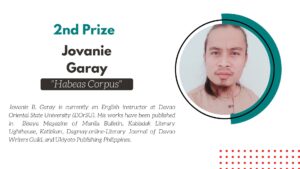
The SECOND PRIZE WINNER for the 6th Satur P. Apoyon Tigi sa Mubong Sugilanong Binisaya is “Habeas Corpus” by Jovanie B. Garay.

Jovanie Garay’s literary achievements include winning prizes in prestigious competitions such as Bathalad Mindanao (2019) held in Iligan City, LUDABI (2020) in Valencia City, and Sunday Club (2021) Tigi-sinulatay.

Jovanie was a fellow for Balak (Poetry) in the 59th Silliman University National Writers Workshop (SUNWW) in 2021 and the 21st Iyas National Writers’ Workshop in 2022 for his sugilanon (fiction). His recent writings have been featured in publications such as Sands and Coral of Silliman University, Pagsubang 2023, and Space and Time of the Kinaadman Journal, Volume 44, published by Xavier University Cagayan.

“Habeas Corpus” will appear in its complete version on the Dagmay website and will be serialized in Sun.Star Davao.

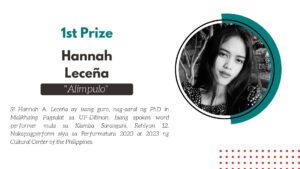
The FIRST PRIZE WINNER for the 6th Satur P. Apoyon Tigi sa Mubong Sugilanong Binisaya is “Alimpulo” by Hannah A. Leceña.

Hannah Leceña was a fellow in the Davao Writers Workshop 2018, Iligan National Writers Workshop, IYAS National Writing Workshop, Silliman University National Writers Workshop, 5th ALBWW, 16 Palihang Rogelio Sikat and the 11th Kritika Workshop at the De La Salle University.

Her fiction has received  the Jimmy Balacuit Literary Awards, Satur Apoyon Prize, the PNU sa Normal Awards, and the Nobelang Pangkabataan at Grand Prize Winner in the Lampara Prize, Middle Grade Category. Her writing has appeared in Diliman Review, Dx Machina Volume 5, Luntian Online Journal, Kawing Refeered Journal among others. He novel Jonas, published by the Komisyon sa Wikang Filipino, is her first book. She is a members of the Sarangani Writers League and SUSI. She is also a recipient of Publication Grant 2022 from National Book Development Board.

“Alimpulo” will appear in its complete version on the Dagmay website and will be serialized in Sun.Star Davao.

The 6th Satur P. Apoyon Tigi sa Mbong Sugilanong Binisaya received entries from Davao del Sur, Davao del Norte, Davao de Oro, Davao Oriental, Davao Occidental, Lanao del Norte, Zamboanga del Sur, Zamboanga del Norte, South Cotabato, Cotabato, and Sarangani.
This year’s first prize winner receives P8,000.00, the second prize P6,00.00, and third prize P4,000.00.