My Last Prayer

Fiction by | February 22, 2021

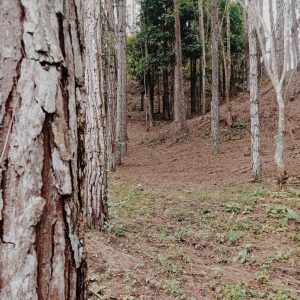
 It was just a little after lunch and the sun was high up but the forest around felt colder as we ventured deeper, the trees felt as though they had eyes, looking directly at us from all directions, above, the tree branches served as a canopy for the whole area, casting grotesque shadows on the ground and in the river parallel to our path, each step we took wearied us down as though the very earth had little hands that gripped our feet. The wind howled and moved through the plants around, making them dance, I felt as though I was in the middle of some kind of strange ritual, no words were spoken among the three of us since the trip started. I wanted to rest, I wanted to stop, I wanted to turn back. But I couldn’t. I was the one who suggested this, I was the one who invited them, I was the one who asked for this.

A shadow, a sound, a movement in the thick bushes around, the forest seemed to play tricks on us. JC stopped abruptly halting the movement of the whole group. We stood there for what felt like ten seconds or a whole eternity. “Maybe we should rest here for a while,” Irene said. “No, I feel like there’s something bad here. Let’s rest when we get there,” JC replied. It was only two in the afternoon but the forest felt really cold, and my wet clothes gave me chills whenever the wind howled. My head was spinning and I felt like throwing up. I felt like there were chains attached to my feet, and it was the forest holding the handle at the other end of it. We have been walking for two hours but I had a feeling we weren’t any closer to our destination.

 A fork in the road appeared upon us. JC took a minute before deciding which way to go. The path we took went outside the forest and up a slope that was filled with jagged rocks, pain for my exposed foot. The skies opened before us but it was slowly turning gray, signaling rain. The road continued to a narrow path on the side of a mountain where we had to walk in single file, to the right was the face of the mountain, and to the left was a steep downward slope. We kept looking at the sky, praying that the rain wouldn’t come.  The path went down and into the forest again. It was the same forest but this part felt totally different. I felt like it was another world; I felt like it was from a different time, a time long past and forgotten. The trees were bigger, and there was a feel to them that made it seem like they moved every time we weren’t looking, their roots intertwined with everything on the ground, covering everything.

It was dark and I was sure it was close to dusk. Just a little further we walked, and there it was, the tree with the red stripe painted around its trunk, and to its right was the spring, it was dim but the water sparkled, we climbed upwards through the spring rocks, one little slip to what would be a dangerous fall but onwards we climbed, carefully planning each step. It should have been getting lighter because we were climbing upwards into the open space but the light remained the same; it seemed that the rain would pour any minute. My body felt so exhausted, every flex and contraction of my muscles caused me searing pain, and my feet felt like they had needles pinned to them but at last, we were there. Atop the spring rocks was a small cave, the darkness inside of which was a totally different kind of darkness and the light from our matches only managed to illuminate our hands. I felt for something in the darkness with my feet, a rock with a depression in its center that made it look like a moon crater. Beside the rock, was our destination.

“How long has it been, since we last saw you, John?” The words echoed in the cave and sounded like they were not words. The wooden cross beside the rock illuminated by the weak firelight had no words engraved in it, a marker with no name, it lay motionless and dead, like the person buried under the rocks beneath it, but I felt it calling out to me.  My knees finally gave out, maybe it was fitting for me to kneel before it, emotions and memories ran wild in my thoughts, JC and Irene stood there behind me, silent. In the quiet dark I kneeled, In the quiet dark I remembered. In the quiet dark, I started to pray.

__________________


Jose Francis R. Sycip is from Bukidnon. He is a 1st year Creative Writing major from the University of the Philippines Mindanao.
Ayuda in Five Acts

Nonfiction by | February 8, 2021

ACT ONE: Homecoming

By a stroke of luck, or divine intervention, I had a pre-scheduled trip home to Mindanao and was already armed with a plane ticket for March 14th. I had been studying at a university in Manila, and decided in early February that I needed a short break from the rigorous academics. Because of that spur-of-the-moment decision, I missed getting caught up in the Manila lockdown by mere hours; my flight was one of the last they allowed to take off. My grandmother and uncle met me at the Ozamiz airport, expressing their disbelief at how close I had gotten to waiting out the pandemic alone and in a city that did not speak my mother tongue.

But I had only traded one prison for another – a cage of smog and neon lights for a cage of the over-familiar. The moment I returned to my hometown, they put me in quarantine – a kinder word than ‘house arrest’, though similar in its rigidity. I was lucky enough to live just ten paces away from my extended family, so though I was a prisoner, I had fellow inmates willing to spend their afternoons playing badminton with me. For two weeks, I was content with watching shuttlecocks arc gracefully over my grandmother’s garden while outside our gates, the town became quieter and quieter.

And then, on the fourteenth day, I was informed that one of the people on my flight home had tested positive, and so my sentence was extended. We waited to see if I would end up on death row.

I paced aimlessly, a nameless, nebulous fear breathing down my neck. The virus had been a distant thing – someone else’s problem – but now it was knocking at my door. All too suddenly, the panic and apprehension that I had only seen on the news were now my own. Obituaries were only words until you recognized the names.

Every small cough was proof against my innocence. My family watched from afar as I obsessively monitored my temperature – the numbers that would determine my fate. Through it all, I could not find comfort in their arms; I was Judas in the garden and my kiss could doom them all.

Eventually, I was cleared of all charges. I did not lose my sense of smell, I did not get feverish, and my lungs did not collapse. But the rest of the world did.

No matter, I thought to myself, trying to scrounge up some inkling of hope as I watched a lone tricycle driver pedal down the empty road from my bedroom window. No matter. This, too, shall pass. 

ACT TWO: Perspective

It could have been worse. I heard it in the weary sigh of my dormmate, a probinsyano stuck in our sprawling dorm complex, doomed to numbly pace the hollow hallowed halls like an addition to its pantheon of ghosts and trickster elves. “I want to go home.” His voice cracked from the weight of his isolation. “I just want to go home.”

It could have been worse. I saw it in the unending march of Facebook posts across my timeline – ayuda, they called out in a colonizer’s language reclaimed, help. I send as much aid as I can to as many people as I can, and still here was another, and another, and another. Ayuda, ayuda, ayudame. Ayúdanos. 

It could have been worse. I felt it in the despair of my fellow citizens. They wasted away while the government wasted time, occupied with senseless nonsenses (many of their own invention). The masses took to the streets – organized, following all protocols, armed with righteous fury and cardboard signs. They were dispersed by the boys in blue whose father’s crimes still go unpunished. And across the country, I languished alone, my nails digging crescent-moon dents into my palms.

ACT THREE: A Video Call

“I know, I know, I miss you, too. It’s been too long since—yes, yes, I promise, after the lockdown, we’re going—okay, okay. How’s your boyfriend? What? What do you mean you broke up? When? Four months ago? Why didn’t you tell me? You could have at least called, you know! … I’m sorry. It’s just… I’m not used to not seeing you every week, I guess. I used to know you so well and now it’s… yeah. Yeah. I know. It’s not our fault. It’s been tough for everybody. Don’t apologize. Don’t be sorry. No, please don’t cry, it’s—Hello? Hello? … Damned PLDT.”

ACT FOUR: Perspective (Reprise)

And life went on. Lockdowns were lifted. People strolled leisurely through the park, their words muffled by cloth masks. I looked outside my bedroom window one day and, for once, was grateful to see traffic. I paid tricycle drivers twice as much as the usual fare, and I toasted to my stranded friends’ homecoming.

And life went on. On my flight home so many months ago, the pretty attendant had gestured to the place above our heads where the oxygen masks would drop down in case of an emergency. “Please mind your own mask first before tending to others,” she’d told us then, repeating the instructions from the laminated manual I had not bothered to pick up. I now understood that, sometimes, the best advice you could ask for can be found on the back of an airplane’s safety information card.

And life went on. Classes were now held online, substituting blackboards with laptop screens, and chalk with Google Docs. I was hounded by deadlines and requirements, but it was better than being hounded by fear.

Still, some days, I found myself counting how many times my classmates got disconnected from a Zoom meeting. I counted how many times they apologized for slow signals and brownouts. I watched news of jeepney drivers begging for food, frontliners begging for hazard pay, teachers begging for time. Because life went on – but not for all of us.

ACT FIVE: Respite

We went to the beach last week. When our car stopped at the edge of the surf, my young cousins were quick to remove their clothes and stumble into the shallows, heedless of their mothers’ cries of, “You forgot your sunblock!” One cousin dove at the other, their small heads disappearing under the murky water for a few seconds before they resurfaced, guffawing. I couldn’t help but smile. I had forgotten how sweet laughter sounded under an open sky.

“Are you coming?” my grandmother asked.

“Maybe later,” I said, and kissed her cheek.

I sat back, watching her wade into the ocean, her little body cutting through the waves with ease. The sun was scorching my skin; I imagined it burning away the paleness I had acquired in my eight months of captivity. I breathed in, out, in, out. I tasted salt on my tongue, felt the sea breeze toying with my hair.

The sea stretched on, farther and farther, into the blue horizon. And though the tide had pulled away, I knew it would always come back to the shore.


Kyndra Lei “Kyle” Yunting is from Zamboanga del Sur and currently a BA English student of UP Mindanao. She credits her passion for writing to reading the Percy Jackson and the Olympians series at a formative age, and also to her high school paper adviser.


Maria Al Qibtiyya

Fiction by | February 1, 2021

(For All The Sitties And Josephs)

Forgive me, Mother, for I may have sinned. I am with someone.

You taught me to cover my head, which I followed all through my adult life. But one morning I grew impatient. I discovered it was less stifling to let loose some strands of hair. The wind was cold, so I let it through.

Sinned, in the language of Baba. But you, you did not teach me to guard my heart. You encouraged me, in your silence, to find happiness as long as I kept my virtue, especially my faith. I am keeping my word. Would sin then include welcoming into the fold a man who has willingly embraced our beliefs and customs? That he and I shall serve the Almighty together. I am always to remember that Jannah1 is beneath a husband’s feet.

[Photo by Jhoanna Lynn B. Cruz]

Forgive me, Mother, for I may have failed you. I chose someone for myself.

I know the story of Umm Sulaym and Abu Talhah2. I learned how she was told it was better for her that Allah guided one person to Islam through her. I followed the honorable woman of the past like a dutiful daughter. I know the standards, beginning with a man’s religious commitment, seconded by his attitude and then physical attributes and financial ability. Most importantly, I am empowered by our faith to choose my own husband.

I chose well, I must say. Would you still think me as a failure when he has passed the test?

You made sure I was wrapped with royalty. I assure you the sound of the kulintang follows me everywhere. Once, when I visited his home to meet everyone, I thought I heard an agong cheering me on.

They too are royalty. They talked casually about their jobs at topmost government offices and trips to Europe. I saw attractive wood carvings and fine china. The decorations on that particular December night were so refined I invoked Astagfirullah3 for yet again appreciating the season. I invoked Astagfirullah many times as I let myself hum along Christmas carols that danced around me.

How sophisticated they are and well-mannered, the crowd in Montiya would surely be mesmerized. They said my hijablooked delicate and beautiful as my skin. Would you feel betrayed if I say I like them better than some of our inquisitive relatives?

Mother, I wear my dignity like a crown. He has committed himself to Allah so that he can marry me.

Would you dispute the holy words now and blindly call me a sinful woman or a failure of a daughter?

Hear me. Hear this verse as it was constantly recited in the halls of matrimony, “And among His Signs is this, that He created for you mates from among yourselves, that you may dwell in tranquility with them, and He has put love and mercy between your hearts.”

Mother, I have already made up my mind. Please bless us with your consent and acceptance.


Notes:

1 Paradise. Islam says a woman who prays her 5 obligatory prayers, fasts during Ramadan, and honors and respects her husband may enter Paradise by any of its gates she wishes. Islam likewise teaches the equal obligation of men to live with their wives in kindness and devotion—“the best among you are those who treat their wives well.”

2 One of the finest men in Madeenah during Prophet Muhammad’s time. He converted to Islam to marry Umm Sulaym.

3 Invocation for repentance


Arifah Macacua Jamil was raised in Lanao del Sur. She graduated from the BA English program of UP Mindanao. Currently based in Manila, she likes to talk to children.